AV1 in Ringebu Municipality: A Safe Bridge Back to the Classroom Community
AV1 gives pupils in Ringebu a safe, supportive bridge back into the class and school community.
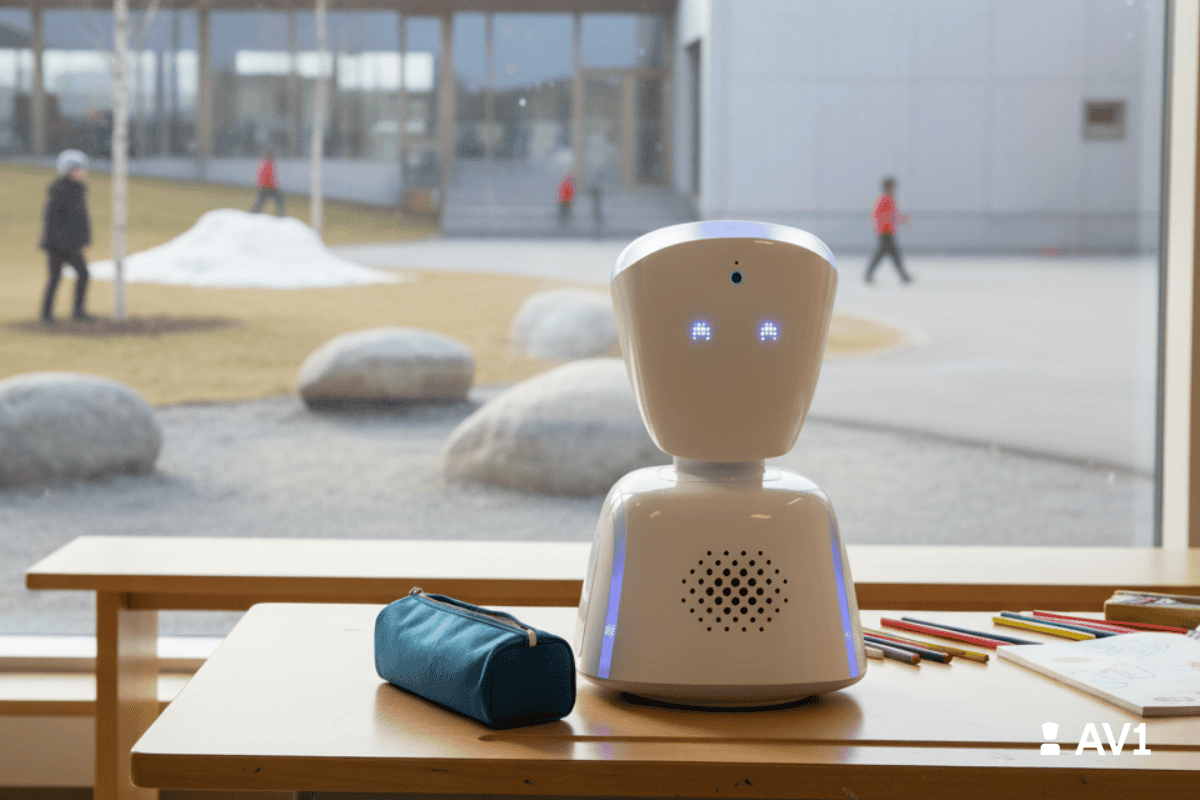
Ringebu Lower Secondary School in Norway uses AV1 as a safe and supportive bridge into the classroom community for pupils who, for various reasons, are unable to attend school in person. Rooted in a strong school culture focused on safety, inclusion and relationships, AV1 is used not primarily as a piece of technology, but as a pedagogical and social support.
With the support of inclusion practitioner Rita Berget Moen, AV1 enables pupils experiencing school absence, neurodiversity or serious illness to follow lessons taught by a qualified teacher while maintaining meaningful contact with their classmates – often serving as a gentle stepping stone back into the physical classroom.
At Ringebu Lower Secondary School in Norway, community in everything. Staff works purposefully to create an environment where every pupil is noticed, included, and feels safe – whatever their starting point. Educators take an active role in pupil’s day-to-day lives, helping to build calm, belonging, and a culture where difference is understood as a natural and valued part of school life.
At the centre of this is Pastoral Lead Rita Berget Moen. She supports pupils who, for a range of reasons, are unable to take part in regular classroom teaching: pupils experiencing school non-attendance, those with special educational needs, and pupils living with serious illness. What they all share is a risk of losing contact with their class – and with it, access to learning, friendships, and the routines of everyday school life.
This school culture is the foundation for everything. Within this framework, AV1 has found a natural role – not as a piece of technology, but as a way of protecting community, continuity, and belonging.
“My experience was that some pupils were missing out of the classroom community unnecessarily. That’s when AV1 became interesting,” Rita explains.
From Need to Solution: How Ringebu Started Using AV1
Rita first came across AV1 during her studies, long before she needed it in Ringebu. The turning point came when she was supporting a pupil who had stopped attending lessons altogether. Academically, the pupil was strong, but completely disconnected from their classroom environment. The school faced a clear dilemma: How to ensure fair access to learning when the pupil cannot be physically present in the classroom?
When Rita introduced the idea of using AV1 to the headteacher, she discovered that Ringebu Municipality had actually used the robot before. The concept was already familiar, and the decision to reintroduce it came quickly. Today, the school keeps two AV1 robots available for use whenever needed.
Day-to-day coordination fell naturally to Rita: “The pastoral role is a bit like a big umbrella – we work across wellbeing and inclusion, and we’re often involved when a ‘typical’ school day becomes difficult for a pupil. So it made sense that I took responsibility for AV1,” she explains.
At Ringebu School, relationships always come first. Before AV1 is introduced, the school works deliberately to build safety and trust around the technology: “We place strong emphasis on relationships. Pupils need to feel seen, heard, respected and understood. Once they feel safe, we can start using AV1 to help them take the first steps back towards the classroom,” says Rita.
For many pupils, AV1 has become exactly that – a bridge back into the school community.
Before AV1, pupils who struggled with the classroom typically worked one-to-one with a teaching assistant in a small, quiet room. While this provided calm, it also limited the academic depth and continuity of subject teaching.
“When you’re following a lesson plan on a one-to-one basis with an assistant who isn’t a trained teacher, it’s hard to offer what a subject specialist can provide,” Rita notes.
With AV1, pupils can work from another room – often with Rita or a colleague – while the robot sits in the classroom. They receive the same teaching as their peers, with the added benefit of discreet support from a trusted adult.
This approach has become a valuable supplement to special education provision and individually tailored support at the school. In dialogue with the Educational Psychological Service (known as PPT in Norway), the school has confirmed that lessons followed via AV1 – combined with input from the classroom teacher – can fulfil the requirement for special-education hours.
“It’s really the best of both worlds,” Rita says. “Pupils get teaching from the subject teacher, and we can support them socially – without drawing extra attention to them.”
When the Classroom Feels Overwhelming: AV1 as a Gentle First Step Back
For some pupils, absence is less about academics and more about how the classroom feels – noisy, intense, or full of sensory impressions that become too much. For them, walking straight into a full class can be an impossible step. Here, AV1 has become an important intermediate stage — a way to be present without facing the physical environment immediately.
For one pupil, this was decisive. Through AV1, the pupil could sit in a separate room with a trusted adult while still hearing classmates, sensing the atmosphere, and observing the classroom dynamics. This allowed them to build safety through experience.
Rita describes how the pupil’s courage grew:
“At first, they didn’t even want to sit in front of the screen because they were terrified the others could see them. But once they realised that wasn’t possible, they began to enjoy being a ‘fly on the wall’ – hearing the jokes, catching the funny moments, noticing when classmates laughed… all the small things. That’s when they started to think: Those are my classmates again.”
For some pupils, AV1 is a temporary tool that makes choosing the physical classroom easier. Rita mentions a pupil who decorated the robot with stickers because they thought it was fun, but after a short time preferred to join the class in person after all.
“She chose the classroom instead of logging in through AV1. That was a great outcome.”
Clear routines are important when pupils participate from home. In one case, the pupil and parents agreed that if the pupil went home exhausted, the rest of the day would be followed via AV1 – an arrangement that organically motivated the pupil to stay at school longer.
How Teachers and Classmates Experience AV1
Teachers and classmates also have positive experiences with AV1. Classmates often help move the robot to group rooms or the science lab, chatting with it on the way – creating natural interaction with the pupil using the robot.
“Classmates become more aware of the pupil who hears them in class but isn’t physically there – always in a positive way,” says Rita.
Among teachers, there can be some initial uncertainty, especially among new staff. But experience shows this passes quickly.
“We’ve had teachers say: ‘Just take a screenshot and you’ll see.’ And of course, the solution locks immediately, which reassures them. After that, they quickly realise that teaching with AV1 in the room is not different from teaching any other pupil.”
The robot’s presence does not change how teachers teach – it simply makes it possible to include one more physically absent pupil.
Impact and Experience: A Small Robot with Big Meaning
For Ringebu, AV1 has opened doors for pupils who would otherwise remain on the margins of school life. It enables them to access subject teaching, support from a trusted adult, and stay connected to the social community they would otherwise lose. Some pupils who had been far removed from the class have moved closer again, while others have been able to maintain meaningful contact during periods of illness. A few have even returned to school in person sooner than expected.
For staff, AV1 makes it easier to maintain high academic quality without tying up large resources in one-to-one teaching. Teachers can teach as usual, while environmental counsellors support pupils closely without disrupting the lesson.
Rita sums up what AV1 means to her and the school:
“It gives pupils who – for different reasons – cannot take part in the classroom community the opportunity to do exactly that, without the physical confrontation of walking into the classroom.”
For Ringebu Lower Secondary School, AV1 is a tool that supports the school’s core values: safety, community, and equality. When the relationship is in place, the robot becomes a gentle, safe bridge back to the class. It makes it possible to provide continuity in learning and friendships even when life is difficult.
In Ringebu, this is ultimately about something much bigger than a robot in the classroom. It is about giving children and young people a real chance to belong.

A transformational solution to attendance and reintegration.
Talk to an expert
.jpeg)

.png)