How a Multi-Academy Trust School Uses AV1 to Support Autistic Learners
A compassionate model for keeping autistic pupils connected to school.
%20template%20(12).png)
When a Year 11 pupil at Corley Academy, Thrive Education Partnership, received a cancer diagnosis, the school faced a painful reality: one of their most engaged, performance-loving students might no longer be able to attend the place he adored. Rather than wait and see what would happen, Headteacher Mark White decided to act. Within minutes of recalling an AV1 robot he’d once seen in a magazine, he was asking his business manager to purchase one so that this student could keep accessing school life.
That decision set Corley Academy on an AV1 journey that now stretches from hospital corridors to “train club”, from transition support to future-thinking ideas about exams, all rooted in autistic pupils having safe, meaningful control over how they connect.
A Specialist Setting Between Two Worlds
Corley Academy is a secondary special school for young people with complex communication difficulties. Every pupil has an Education, Health and Care Plan, and all have a diagnosis of autism.
The school occupies a distinctive space “in the middle”. It is designated a special school, yet runs a full GCSE curriculum.
Pupils follow one of two pathways:
- A core curriculum that mirrors a small mainstream secondary, with autism support embedded throughout.
- A life skills pathway for those who struggle with moving between multiple teachers, following a more primary-style model with higher support and vulnerability in mind.
When Mark first joined the school 14 years ago, there were 72 pupils on roll. Today there are around 170. He links this growth to rising demand for specialist places and improved autism diagnosis – including a marked increase in girls, from just a handful to more than thirty.
Set in beautiful grounds on the Coventry–Warwickshire border, with fields and cows at the fence, Corley Academy has a calm, rural environment. Behind that tranquillity, however, lies the complexity of supporting autistic learners with high levels of anxiety, rigid routines and deep attachments to school as a safe, structured place.
Max’s Story: Acting Fast to Keep a Pupil Connected
The school’s first AV1 was purchased for a specific young person, Max, a Year 11 pupil whose cancer diagnosis shook the whole community. He loved school, thrived on performance and was a central figure among his peers.
Mark remembered reading about AV1 in passing – an idea he had mentally “filed away” until that moment. Once Max could no longer attend, he did a quick piece of research, found AV1 again and made a decision: they would not wait for external systems to catch up. The school would buy a robot so Max could be present whenever he felt well enough.
In a striking twist, a charity called SpecialEffect then contacted Max’s family offering to donate an AV1 for him. By the time the call came through, Corley Academy had already bought one, leaving them with two robots for a period: one dedicated to Max, another spare for wider use.
For Max, AV1 became a bridge between treatment and normality. He could log in from home or from the car on the way to hospital, see his teachers and peers, and take part in school life even when his body could not be in the building.
A Seat at the Leavers’ Assembly
One of the most powerful moments came during the school’s Year 11 leavers’ assembly. Max’s step-brother, a year above him, was in the hall with his peers for the celebration. Max was travelling to Birmingham Children’s Hospital for treatment and could not attend.
The staff set his AV1 on a table among the students, facing the front of the hall, while Max connected via laptop from the car. As speeches were made and achievements celebrated, he watched the assembly live, hearing the same words and sharing the same view as his classmates.
For Mark, what mattered most was control and agency. Max could look around the hall, follow what interested him and respond in real time. Staff could not mute or turn off the robot from their side; they spoke to the AV1 as if they were speaking directly to him. It was, in every practical sense, his seat at the table.
That experience cemented AV1 not as a piece of equipment, but as a way of preserving dignity and participation for a young person in an exceptionally difficult situation.
Sharing the Model: Lending AV1 to Another School
With two robots on site and Max fully engaged with his own device, Corley Academy had a spare AV1 available. Around the same time, Mark’s partner – who works at a nearby school – was trying to support a Year 11 student who was no longer attending.
They loaned out their second AV1 for several months, allowing the other school to test the approach for themselves. The impact was strong enough that they subsequently purchased their own robots.
That experience reinforced an important point: once staff see AV1 in action with a real pupil in mind, it becomes much easier to understand its value and commit to using it.
Small Steps and “Train Club”: Opening up George’s World
Today, Corley Academy has one AV1 on site (the charity robot has since been returned). At the time of the conversation, everyone who should be in school is attending – with one exception: a boy who has been on roll for six months and whose anxiety is so intense that the team have never yet seen him in person.
He currently accesses only one activity: “train club”, held twice a week. This club meets in a classroom, watches live feeds of trains passing through stations, reads train magazines and builds tracks together.
The pupil joins train club through the AV1, which staff refer to by his name. A former student who now works in the office carries the robot to and from the club in a bag, sets it up, and returns it for charging afterwards.
The boy does not yet speak through the robot or actively participate, but he consistently logs in and looks around the classroom. Recently, his parents shared a significant update: he has started leaving the house to go in the car, which is a major step forward.
Mark is careful not to attribute this change solely to AV1, but he does see a connection. The robot has allowed the boy to see peers who share his special interest, in a familiar, predictable format, without demanding anything of him that he is not ready to give. It is a genuine “small steps” pathway – one that feels appropriately graded for his anxiety and needs.
Why AV1 Works Where Video Calls Didn’t
Corley Academy’s use of AV1 is shaped by hard-won experience from the early months of the COVID-19 pandemic.
When schools first closed, the team trialled Microsoft Teams with one family as a possible route for remote learning. It quickly became clear that this approach did not fit their pupils. For autistic learners at Corley Academy, home and school are usually kept as distinctly separate spaces. Home is where they decompress; school is where they engage with structured learning.
Introducing a live video feed into bedrooms blurred that boundary. Children were suddenly confronted with an adult from school appearing in their personal space, while simultaneously seeing into the teacher’s home. The experiment felt intrusive and unsettling on both sides, and the school concluded that conventional video conferencing was not appropriate for their cohort.
AV1 is different.
For pupils, AV1 offers:
- One-way visibility: they can see the classroom, but staff cannot see into their home.
- Clear boundaries: school remains “over there” in a familiar form (teacher, board, peers), without entering their private environment.
- Control: they decide when to log in, where to look, whether to signal a wish to answer or simply observe.
For staff, it removes ethical and safeguarding concerns about seeing into children’s bedrooms or inviting pupils into their own homes virtually. The interaction is framed firmly as “school”, even though the pupil is physically elsewhere.
A Flexible Offer for Anxiety, Transition and Reduced Timetables
Although medical needs are relatively rare at Corley Academy compared to some settings, anxiety is common and often severe. Mark now sees AV1 as part of a wider offer for pupils whose emotional needs make attendance difficult.
Examples of how AV1 fits into their current and planned practice include:
- Transition support: For prospective or new pupils who are too anxious to enter the building, AV1 could be used to offer virtual tours of corridors, classrooms and outdoor spaces, or to let them observe a specific lesson of interest before they attend in person.
- Supplementing reduced timetables: Where a pupil attends on a part-time basis following advice from CAMHS or other services, AV1 can extend access to lessons on the days they are at home, using new codes as needed.
- Responding to emerging anxiety: For pupils whose school-based anxiety spikes suddenly, AV1 provides an interim way to stay connected, rather than moving straight from full attendance to complete disengagement.
It is not a replacement for in-person provision, but a flexible tool that can be offered “on the shelf” when needed, particularly for those whose difficulties are rooted in anxiety rather than physical illness.
Looking Ahead: Governance, Exams and Future Potential
Mark’s thinking extends beyond individual cases to broader system questions. He has discussed AV1 with governors as a possible tool for classroom visits that minimise disruption for autistic pupils, who can become highly dysregulated by additional adults in the room. A robot presence could allow governors to gain insight without adding to sensory or social load for learners.
He has also begun conversations with exam boards and regulators about how assessments might better reflect the needs of neurodivergent students. Having heard about remote exam setups that use multiple cameras to monitor candidates at home, he has raised AV1 as a potential part of future models – for example, helping a young person access an exam environment without physically entering it.
These ideas are still exploratory, but they illustrate how their experience with AV1 is shaping wider thinking about access, fairness and inclusion.
Culture, Trust and the Power of the Story
One of the most striking aspects of their AV1 journey is how little resistance there was from staff. Mark attributes this to the way the technology entered the school: through Max, a pupil the community cared about deeply.
Because the initial use case was so clearly about supporting a much-loved student at a time of crisis, colleagues focused on what the robot made possible rather than on abstract worries about cameras, data or GDPR. By the time questions arose, people had already seen AV1 functioning in context – as a lifeline, not a surveillance device.
Visitors on school tours have had similar reactions, particularly when they encounter AV1 in the middle of a real lesson: a teacher teaching, a pupil interacting through the robot, other students treating it as a normal part of the classroom. It is often only when people see that scene in action that they fully appreciate what AV1 can do.
Lessons for Other Leaders
Corley Academy’s experience offers several takeaways for leaders considering AV1 for autistic learners and other neurodivergent pupils:
- Anchor it in real stories. Introducing AV1 in response to a specific, human need helped staff and families understand its purpose and value.
- Prioritise agency and safety. One-way visibility and pupil control over engagement make AV1 more acceptable than conventional video calls for many autistic young people and their families.
- Think beyond “attendance”. AV1 has supported hospital treatment, special interests (like train club), transition anxieties and reduced timetables – always on the pupil’s terms.
- Keep it as part of a menu, not a single solution. At Corley Academy, AV1 is one option within a broader autism-informed offer, used when it aligns with the child’s needs and preferences.
- Use early success to build culture. Visible, positive examples – like Max at his leavers’ assembly – help shift staff from curiosity to confidence.
At its heart, Corley Academy’s AV1 practice is about respecting autistic pupils’ need for control, predictability and clear boundaries, while refusing to accept that absence must mean disconnection. For Max, George and the pupils who will follow them, AV1 is not just a robot; it is a way of being present in school on their own terms.

A transformational solution to attendance and reintegration.
Talk to an expert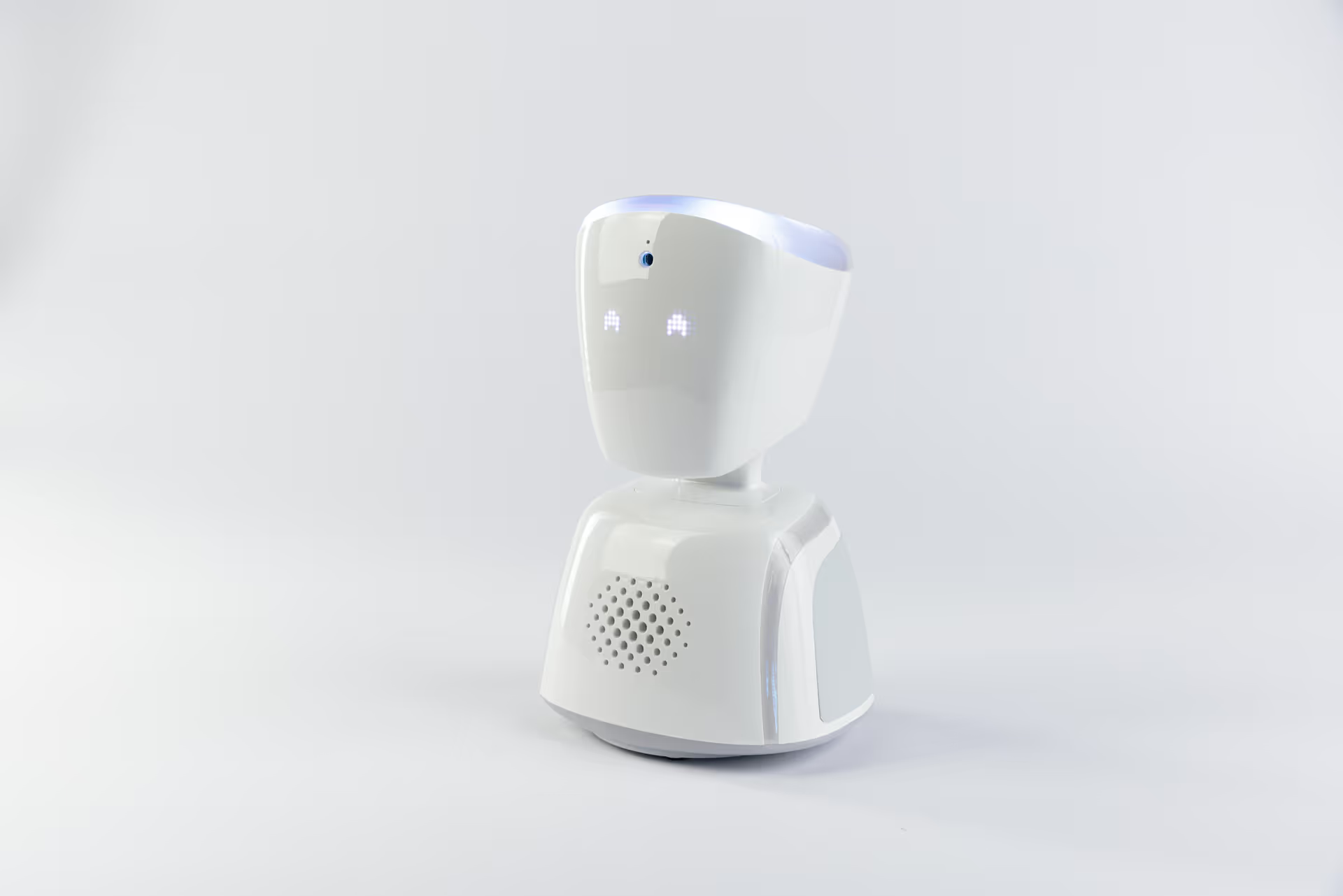

.png)