.jpeg)
Pinderfields Hospital School PRU: A continuous link between home and school with a route back into the classroom through AV1
Pinderfields Hospital School uses AV1 to keep pupils with medical needs connected to education.
%20template%20(3).png)
In Wakefield, no child should lose their place in education because they are unwell.
For Shaun Booth, Headteacher at Pinderfields Hospital School PRU, that commitment has deep roots. The school has served children across the district since 1945, when it was established as part of the NHS offer to educate pupils who were medically unfit to attend school.
“We’ve come a long way since then,” he explains. “We still offer a service of providing education for pupils that are deemed medically unfit, but we’ve changed our image, so to speak.”
Today Pinderfields is one of eight sites providing education for pupils with medical needs across Wakefield, alongside SEND support. Pupils may learn on site, through home tuition, through outreach or, increasingly, through AV1.
“We are a tapestry,” says Shaun, “but we weave together quite well.”
Who Pinderfields supports:
Pinderfields works with young people from Year 7 to Year 11 who cannot attend their mainstream school for medical reasons.
Ben Lee, who teaches maths alongside food technology and statistics, has worked at the school for six or seven years.
“We’re for pupils who can’t attend mainstream school for medical reasons,” he says. “A lot of the time that’s due to mental health needs, anxieties and school phobia. We do have physical health needs as well.”
Elizabeth Ellis, teacher in charge of English, describes the variety of pupils who come through the doors.
“We have children who have perhaps been out of school for quite some time,” she says. “We have children who need our centre for a lot longer than others. We also have children who come from their current secondary school for twelve weeks. We do some intensive work with them to get them back to mainstream education.”
For Elizabeth, that variety is part of what makes the work special.
“No day is the same, which I absolutely enjoy.”
How AV1 works in Wakefield:
Wakefield Council invested in AV1 using central government funding as part of its change programme. Before choosing AV1, the council spoke with other local authorities already using it and heard consistently positive feedback.
The district now has two fleets of robots. One is used by Wakefield’s Educational Psychology Service. The other sits with Pinderfields and is focused entirely on medical needs.
Referrals come from schools and professionals, often supported by a consultant paediatrician or CAMHS. Each one is heard at a panel which decides where the robots will make the greatest difference. The service is free for schools to access.
“It could be for short term illnesses, such as a broken leg,” Shaun explains. “It can be for longer term treatments, where they’re in and out of hospital. AV1 provides a link between being ill, being out of school and then going back in. It really enables them to keep contact whilst they’re off site.”
For Shaun, the defining feature of AV1 is that it keeps a young person connected to their own school.
“The beauty of AV1 is that it allows that contact with the mainstream school to continue,” he says. “They are still part of that school. It’s that continuous link between home and school. We’re providing that conduit, that piece of technology that’s allowing them to do that.”
The fleet has also extended the reach of the service.
“It enables us to have a larger scope and a larger remit and contact with pupils beyond the manpower that we’ve got.”
From a few hours a week to a full timetable:
Ben remembers seeing AV1 on a BBC news report before it ever arrived at Pinderfields.
“It looked really cool and space age,” he says. “You’d never think you’d see that in the school where you actually worked. And then a month or so later we got told we were getting the AV1 robots on behalf of Wakefield Council.”
The difference for pupils has been substantial.
“Prior to having AV1, a pupil who couldn’t come into school would get two or three hours tuition a week,” Ben explains. “Now they can be here full time, doing the same 25 hours a week that the students on site do. It means they’re not missing out at all.”
Since Covid, the school had found ways to keep in touch with pupils learning off site, such as sending work by email. But Ben is clear that it never matched the experience of being in the room.
“With AV1 we’re able to get real live reactions. We’re able to speak to the students and they hear our voices as they would if they were sat in the classroom.”
Elizabeth had a similar experience with platforms such as Google Classroom and Teams.
“Often you were very static up at the teacher’s desk,” she says. “You weren’t able to facilitate everybody in the room. With AV1 they can communicate with us when they’re ready. They can use their colour coded head to let us know when they need to speak to us or when they need some support. And it’s instant, rather than a delayed approach.”
Teaching as usual:
Both teachers describe AV1 as something that fits into their teaching rather than adding to it.
“I’m able to set the robot up and then go straight into teaching,” says Elizabeth. “It’s actually not a hindrance to my workload at all.”
Ben admits he was conscious of the robot when he first started using it. That feeling soon passed.
“I’ve reached a point now where it is no different to normal teaching,” he says. “The only real difference is that I’d email them a worksheet rather than hand one out.”
He describes a lesson from that very morning.
“I was teaching the rest of the class, then said to the student on the robot, ‘Give me two seconds, I’ll just send this email through. Have you got that?’ And I got a reply on the robot: ‘Yes, that’s fine, I’ve got that.’ It’s just the same as teaching students who are live in the room.”
Connection with friends and the wider school:
At Pinderfields, AV1 gives pupils access to the social side of school as well as the lessons.
“They can talk to their friends in the classroom,” says Ben. “They can hear the chat and the gossip that’s going on as though they were here. It massively stops them being isolated in a way that we couldn’t do before.”
Elizabeth places the robot wherever the pupil feels most comfortable, whether that is their usual seat or somewhere else in the room.
“The child can look around the room, they can socialise with peers, they can talk to peers,” she says. “We can have pair activities through the robot. They can scan me wherever I am, so that allows them to have a full, authentic experience in the classroom.”
Pupils who are not ready to use their voice still have a way to take part.
“They simply change the colour of their head and I go over and try and work out what they need,” Elizabeth explains. “At lunchtime and break time in particular, the robot can become part of the activity and they can still feel that they’re having connection with their peers, just virtually.”
That inclusion extends to the opportunities the school brings in from outside. When external providers visit, the pupil on AV1 joins in too, from careers talks to horticulture workshops with local providers.
“They’re still getting a true experience of the classroom and the opportunity that everybody else gets,” she says.
Ben shares a moment from the day before filming. A short, light-hearted “guess the crisps” activity, led by the school’s personal development lead, ran over into the start of his lesson just as a pupil joined on AV1.
“I said, ‘Actually, while you’re there, do you want to join in?’ I took a bowl of crisps over to the robot and held them up. A couple of minutes later I went over to my laptop and he’d emailed me: ‘My guess is ready salted Walkers.’ Even though he wasn’t in the room, it makes him feel part of the class.”
From behind a bedroom door to the classroom:
Ben has seen AV1 support pupils all the way back into school.
He recalls one young person who was so anxious at the start that staff visiting the family home had to speak to them through the bedroom door.
“We set them up with the AV1 robot,” he says. “Initially they would just sit silently in the classroom, observing and seeing what was going on.”
Over time the pupil began to use the robot’s interactive features, nodding its head and changing its eyes to respond. Their confidence grew gradually until they were speaking to staff one to one through the robot.
“Eventually, because they built up that relationship with us as teachers, they moved on to coming into the school and being taught on site.”
For Ben, the timing matters as much as the outcome.
“At the end of Year 11 they’re leavers and they’ll be expected to go to college,” he explains. “If we haven’t managed to build that confidence, it’s very difficult for them to go to a new setting. So if we can get them to that place, I feel a lot happier that they’ll go on to have a more successful future.”
He has also used AV1 to help pupils prepare for parts of school life they find harder. In food technology, a pupil can watch a practical lesson from home before taking part in person.
“It lets them be a part of school life so they can sit and watch what’s going on. Then they can be more prepared to come in.”
No gaps in learning:
For Elizabeth, AV1 is especially valuable in English.
“English is very text heavy,” she says. “If a child is absent from school for quite some time, they will miss a huge chunk of that text. AV1 is particularly effective in making sure their learning is not disrupted.”
Last year she taught a student on a partial timetable who used AV1 for the sessions she could not attend in person.
“There were no gaps in her learning because she was able to still access the text from home.”
She also sees AV1 as a gentler way back for pupils who have been out of education for a long time.
“It allows them to have a softer step back into the classroom.”
Part of a wider toolkit:
Shaun is clear that AV1 adds to what Pinderfields already offers and works alongside the school’s home tutors.
“AV1 is an addition to what we already offer,” he says. “We have the home tutors and they’ll never be replaced. It’s really important that we still have that face to face human contact. What AV1 does is add to that. It’s an extra piece of technology that we can use in order to benefit the pupils across the district.”
That flexibility means each pupil’s route can look different.
“A pupil might start off with an AV1 robot, move on to a tutor and then end up back in the classroom,” he explains. “There are so many different ways that you can use it in order to benefit the pupil.”
Support from No Isolation:
Shaun describes the support from No Isolation as positive from the outset.
“Technology, as with everything, can have glitches. That’s very rare with AV1, but whenever it has happened, support has been there to make sure it’s dealt with quickly, in a way that gets the pupil using AV1 as quickly as possible.”
Beyond technical support, No Isolation has offered training and advice for schools considering AV1 and has visited schools directly. Last academic year, a training event in central Wakefield brought together people from across the country, including the CEO of a multi-academy trust from outside the district and guest speakers sharing data on AV1’s impact on engagement.
“They are really accessible and friendly as well,” says Shaun.
Inclusion across a large district:
For Shaun, AV1 also supports the school’s wider responsibilities around inclusion, including the expectations set out in the SEND white paper.
“Inclusion has always been high on the agenda for all schools,” he says. “What the white paper has done is clarify what the government wants in terms of inclusivity. What the AV1 robot does is allow that inclusivity to take place. It means that any pupil who is unable to access their learning in their normal classroom doesn’t fall behind. They engage with their peers and their teachers as well.”
Wakefield’s size makes that reach especially important.
“Wakefield district is a lot bigger than I think people realise,” he explains. “By using technology such as AV1, all of those areas across the district are included in the provision that we’re able to give.”
Natalie Jackson, Assistant Headteacher at Pinderfields, sees that impact clearly in the school’s attendance data.
“We’ve had children come to us through panel who have been on 0% attendance,” she says. “One young person now has 100% attendance due to the use of the AV1 robot.”
That evidence gives the school confidence when inspectors visit.
“When Ofsted come in, we feel confident that we are fully inclusive,” says Natalie. “We have attendance figures that show these children are not being left behind. They are still able to access their education, despite not being physically in the building.”
Why it works:
At Pinderfields, AV1 works because it fits the way the school already supports young people: with patience and close relationships.
Teachers can teach as they always have while pupils stay connected to their lessons and their friends at a pace that feels safe. When a young person is ready, the relationships built through the robot help carry them back through the school doors.
As Ben puts it: “It’s just an amazing way to include students who wouldn’t have otherwise been included.”
What began as technology that once seemed out of reach is now part of everyday life at Pinderfields, keeping young people connected to education and to the future ahead of them.

A transformational solution to attendance and reintegration.
Talk to an expert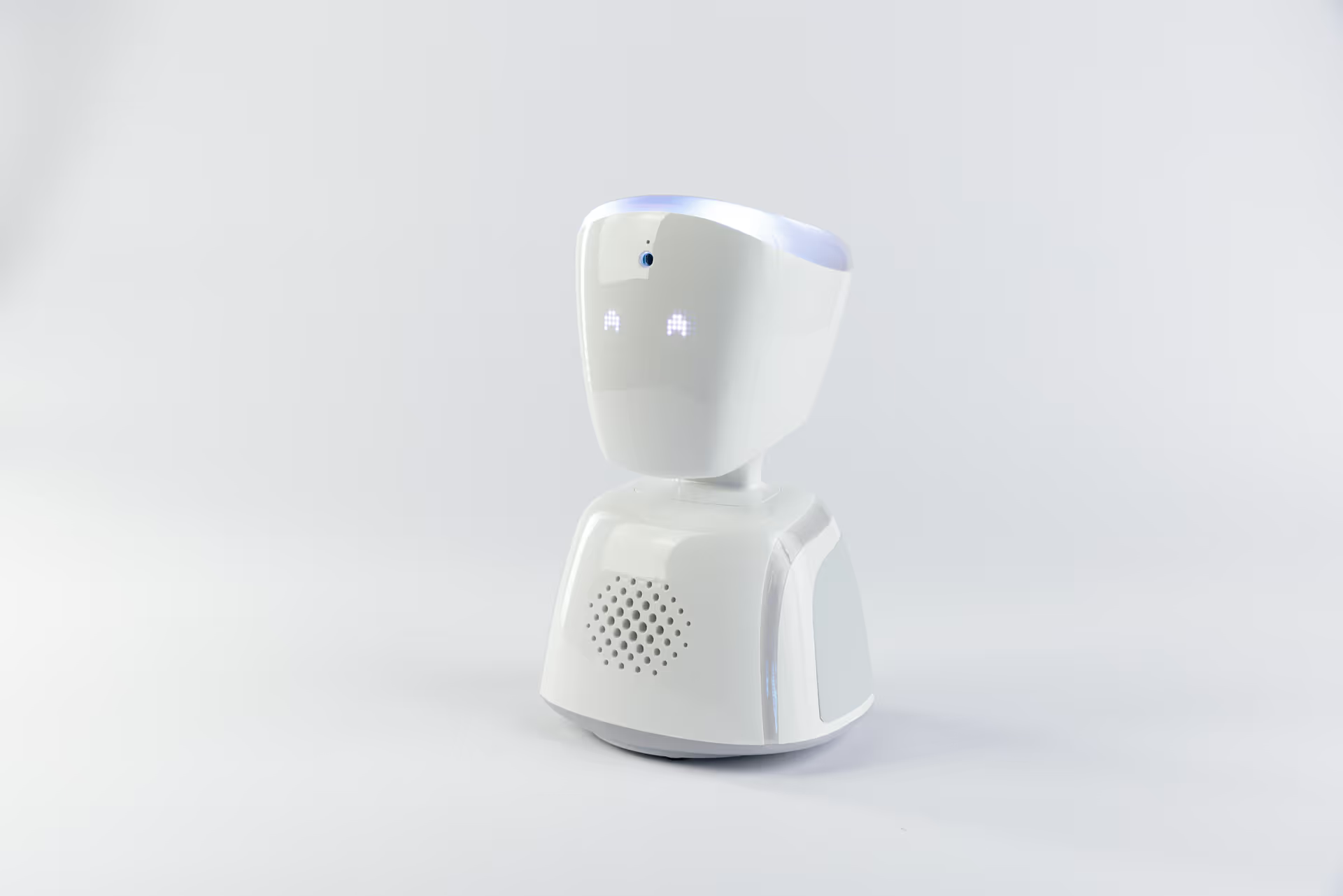

.png)