Using AV1 Attendance Robots to Reconnect Students with Learning, Routine and Qualification Pathways
At Kingsland School, supporting students back into education takes flexibility and patience.
%20(4).png)
The team at Kingsland School work with a wide range of young people, including students with SEMH needs, those affected by emotionally based school avoidance, and pupils requiring support through alternative provision. At the time of interview, around 23 students were accessing online learning through the setting, with three students currently using AV1.
For Phil Pye, AV1 has become an important part of that wider offer, not as a standalone solution, but as a practical way to help students who cannot attend school in person stay connected to learning, relationships and routine.
Building an approach around access
Phil first heard about AV1 on his first day at Kingsland in June 2024, when he was told: ‘You’re getting these three robots.’”
From there, the school began building an approach around them. The main model has been to use AV1 to give students access to Kingsland’s online sessions, joining staff in the school’s online learning hub and taking part in lessons remotely. From there, the aim is often to move students on into what the team calls “live lessons”: on-site sessions where students attend with support and begin accessing teaching more directly.
A hybrid model is also developing, with students using AV1 some of the time and attending in person at other times.
For Phil, the value lies in that flexibility: AV1 can be used to bring students into learning first, then gradually support the next step.
Re-engaging a student with complex medical needs
One of the first students to use AV1 had not attended school for the best part of 12 months due to complex medical need.
His attendance was in single figures, and earlier attempts to find the right support had not worked. A referral to Kingsland’s SLC site was not suitable because of his medical needs, and home tuition was complicated by the fact that there was no one at home with him.
That was when AV1 became a possibility.
The student began online in October 2024 and initially engaged well for two solid weeks. Then, as staff came to understand, a familiar pattern emerged: he withdrew and disappeared from learning again.
Rather than stopping there, the team adapted. With support from online teaching assistant Sue, they rebuilt the relationship and re-engaged him. By December, he was taking another step forward: attending library tuition in person.
Again, the progress was gradual. Staff noticed that even the journey to the library felt difficult at first, so support was adjusted around that too.
“For a few weeks, Sue gave him a lift, stayed with him, and then he was able to walk home.”
Over time, the student was able to gain functional skills qualifications before the end of school.
The AV1 had not solved everything on its own. But it had created the connection that made progress possible.
Qualifications, confidence and a route forward
Another student currently using AV1 is also working with complex medical needs. Phil describes her as a young person who “really, really… wants to learn, she wants to go to school, but those medical needs are just stopping her.”
In her case, the robot has supported both online access and participation in live lessons at the SLC site. Over a 12-month period, she has used AV1 as part of a broader pathway back into learning and accreditation.
“She’s now completed all of her functional skills level 1 and level 2 and passed them,” Phil explains. “So she’s now working towards her GCSEs.”
That matters not only because of the qualifications themselves, but because without AV1 she may not have been able to access them at all.
“The AV1’s given her that opportunity to get the qualifications in the bag and to socialise, because otherwise that young lady wouldn’t have anything.”
More than a screen
One of the reasons AV1 has worked so well at Kingsland is that it has felt different from standard video platforms.
Phil is clear about that difference. While Teams remains useful for sharing resources and for some online sessions, AV1 gives students something more mobile, more personal and more social.
“It’s not sat on a laptop on Teams,” he says. “It’s that device that they’re controlling - their eyes and ears in the classroom.”
Because AV1 runs independently and can move with the student, it allows access beyond a fixed screen. Students can stay connected during lessons, but also beyond them, including at break and lunchtime.
One student using AV1 regularly at the SLC site is able to go outside at lunchtime and sit in the canteen with peers, something that would not be possible in the same way through a standard video platform.
For Phil, that changes how inclusion feels: “It’s as if they’re a person rather than sitting behind a computer screen.”
From novelty to normal
When students first encounter AV1, there is often a moment of surprise.
“They’re like, ‘What? A robot? A robot? Whoa, what’s that do?’”
But Phil says that reaction usually fades quickly. What begins as something unusual soon becomes normal. That same shift has happened with staff. Some were cautious at first, but once they saw AV1 in practice, it became embedded into everyday teaching. Experienced teachers now treat the robot as they would any student physically in the room.
One example stood out for Phil. When a student using AV1 began preparing for GCSE English, a specialist teacher immediately offered extra one-to-one support after school.
“It was no, it was just like it was a student that was on site. ‘I’ll do that intervention.’”
That response says a lot about the culture around AV1 at Kingsland. It is not treated as an add-on. It is treated as access.
Inclusion that stays focused on the individual
Phil believes the reason staff have embraced AV1 is simple: they understand what is at stake.
“It’s supporting a student who otherwise wouldn’t be in school,” he says. “It’s just treating that student… as an individual, not just a piece of data.”
That mindset has helped the school use AV1 not only to maintain education, but to preserve the parts of school life that are easy to overlook until they disappear: conversation, social contact, routine and belonging.
For students who are absent through no fault of their own, those things matter just as much as the lesson itself.
Looking ahead
For now, Kingsland is focused on building further on what is already working: increasing access to live lessons, widening enrichment opportunities and using AV1 more intentionally as part of reintegration.
Longer term, Phil hopes the work can support a broader local authority offer, helping schools think not only about how AV1 can keep students learning, but how it can support the journey back.
For schools considering it, his advice is immediate.
“Just do it.”
For Kingsland, AV1 has already shown what can happen when students who cannot be physically present are still given a real route into education: they reconnect, they achieve, and they begin to move forward again.

A transformational solution to attendance and reintegration.
Talk to an expert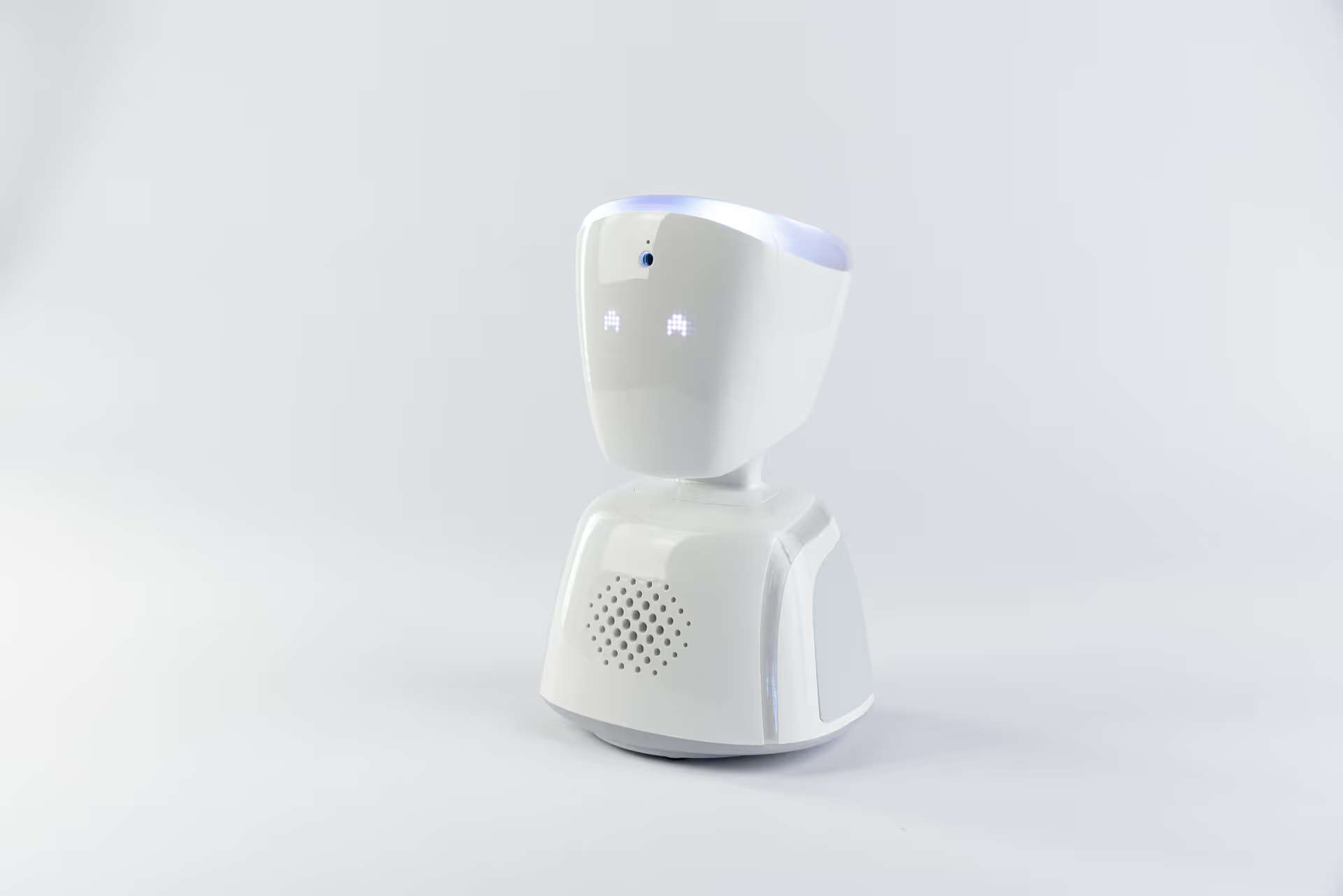
.jpeg)

.png)