.png)
Altofts Junior School: Early intervention, a strong partnership with the Educational Psychology Service, and a route back into school through AV1
Wakefield uses AV1 to support early intervention, engagement and inclusion.
%20template%20(2).jpg)
In Wakefield, inclusion is built on collaboration.
For David Mann, Senior Educational Psychologist at Wakefield Council Educational Psychology Service, that starts with a shared understanding across schools and services.
“I think it starts from a shared perspective of having a child at the centre,” he explains. “Regardless of role, service or remit, I think with the child being at the centre and at the heart of everything that we do, there’s a shared collective responsibility to working towards positive outcomes for young people.”
That joined-up approach has shaped how AV1 is being used across the district. Alongside an existing hospital tuition offer, Wakefield’s Educational Psychology Service has developed an early intervention model focused not only on attendance but on engagement, wellbeing and connection.
Where schools identify a growing concern or an entrenched difficulty, the service works alongside them to explore whether AV1 could help support a child’s re-engagement with education.
“We’ve really focused on not just attendance, but engagement for young people,” says David. “Finding out how we can support schools to embed the AV1 offer as part of the good work and the strong work they already do around inclusion.”
At Altofts Junior School, that approach made a life-changing difference for one pupil.
When the school gates became the barrier:
For Ann-Marie Sheard, SENCO and Assistant Head at Altofts Junior School, the first challenge was not learning. It was simply getting a child through the gates.
The pupil, a Year 4 boy, had become so anxious that even approaching the car park entrance could feel overwhelming. On some days staff could get him through the gates but not into the building. On others, he made it into the playground before becoming visibly distressed.
“You could see his body language just completely change,” Ann-Marie explains. “He’d become so anxious, so upset, so angry.”
The school tried a range of approaches, focusing first on helping him feel safe enough to return. But nothing was working well enough or quickly enough.
At that point, Ann-Marie contacted David Mann and began discussing whether AV1 might offer another way in.
A faster route to re-engagement:
Wakefield’s Educational Psychology Service moved quickly.
Ann-Marie contacted the team and within days the process was underway. An EP visited the school with the robot, talked through how it worked, supported the paperwork and risk assessments and helped develop an action plan tailored to the pupil.
The support continued throughout the placement.
“I reviewed it every week and submitted it so that they could see what was happening,” says Ann-Marie. “She was fantastic because she totally got that it wasn’t going to be a trajectory like that.”
That flexibility mattered. The pupil made progress, but not in a straight line. There were wobbles along the way and the service responded by continuing to support the school rather than rushing the process.
“They said that’s absolutely fine. What we need to do is make sure that it continues to work.”
For David, this kind of early intervention is exactly where AV1 can be most effective.
“We’ve always taken it back to what is the most important thing for this young person at this time,” he says. “It might be around emotional wellbeing support and it might be around allowing them and giving them space to feel connected first and foremost.”
Robot Timmy joins the class:
Before introducing the robot, Ann-Marie met with the family to explain how it could work. The pupil was keen to try it because, in her words, “ultimately he wanted to be in school but he just couldn’t do it.”
There was one important condition. He did not want his classmates to know the robot was him.
That shaped how the school introduced AV1. Ann-Marie explained to the class that they had been chosen as a pilot class to help explore how robots could interact in classrooms and support children. No further detail was shared.
The class embraced the idea immediately.
“They named him Robot Timmy,” Ann-Marie says.
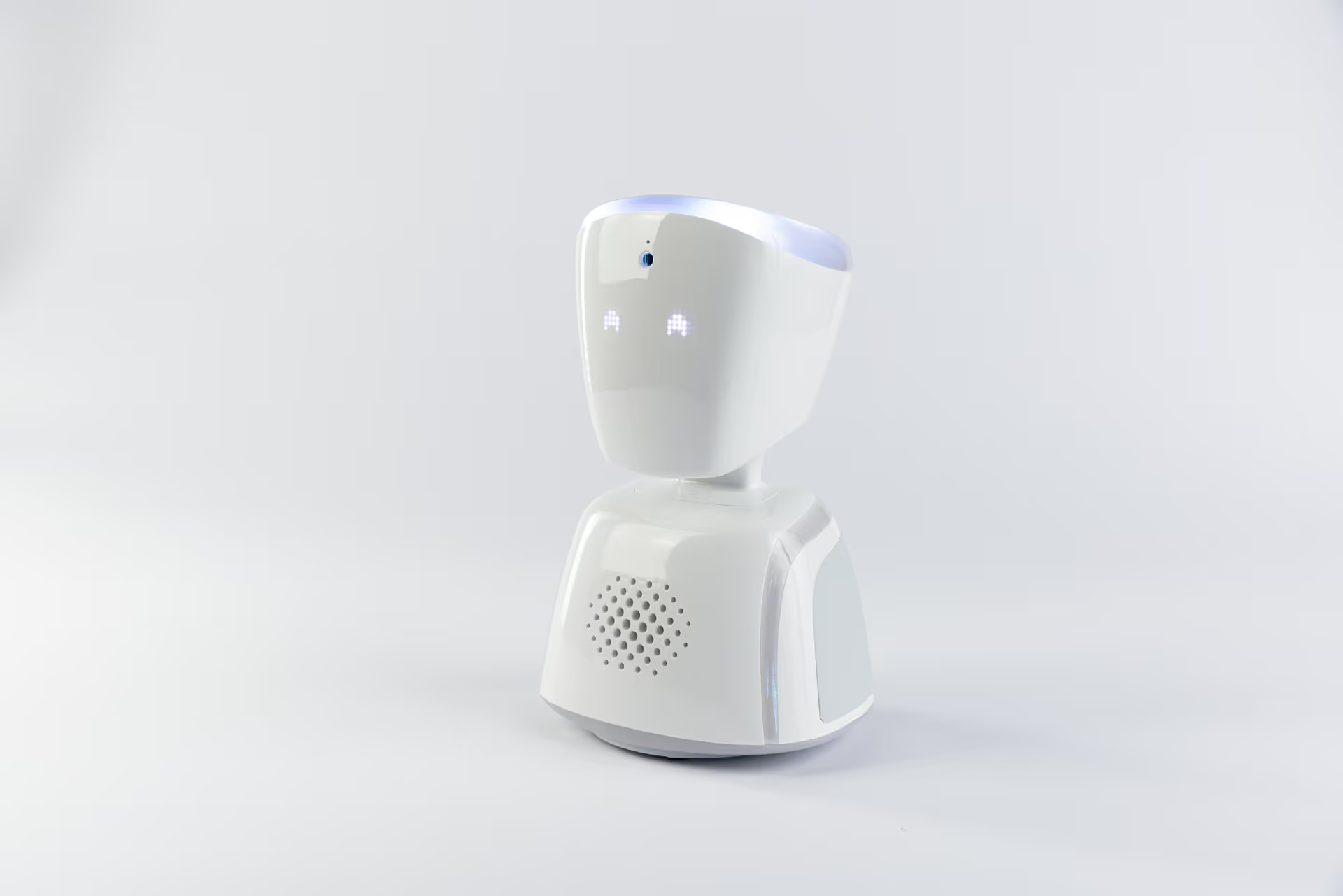
From that point, Robot Timmy became part of the class. He had a place in the room, attended assemblies, joined PE and was taken wherever the class went by the child assigned each day to be responsible for him.
That careful introduction removed one of the pupil’s biggest fears and created a safe way for him to reconnect with school on his own terms.
Rebuilding connection before learning:
The first interactions did not happen in lessons. They happened at lunchtime.
A small group of children sat with Robot Timmy while the pupil joined from home. At first he did not want to speak because he knew his voice would be recognisable, so he communicated through the robot’s eye and head movements instead.
Those early moments mattered because they helped restore social connection before academic pressure was added.
David describes this as a key part of Wakefield’s approach.
“We’ve tried to situate AV1 in terms of the wider support offered across the district to really focus first and foremost on social engagement, emotional engagement and support for a young person through AV1.”
He is clear that for many children, reconnecting socially has to come before reconnecting academically.
“Without a young person feeling safe, secure and connected, they’re unable to learn anyway.”
At Altofts, that proved true. Once the pupil began to feel accepted by his classmates through Robot Timmy, his confidence started to grow.
Small steps back into school:
From there, the school built the plan gradually.
The pupil began by tuning into short parts of selected lessons from home without any expectation that he would complete the work. Over time, that changed. He started listening to teacher input and later completing work at home as well.
As his confidence increased, he began coming into school for very short periods. At first this meant entering the building for ten or fifteen minutes and spending time in the hall or re-engaging with adults. He then returned home and accessed learning again through the robot.
Later, he began sitting just outside the classroom while Robot Timmy remained inside, giving the school a safety net for the parts of the day he was not yet ready to manage in person.
What the school noticed was that as his confidence in being physically present grew, his use of the robot reduced naturally.
“We didn’t put too much pressure on him at that point to be accessing via Robot Timmy because we knew he was coming in regularly,” Ann-Marie explains.
By the end of the following half term, he was back in school full time.
A teacher who made it work:
Ann-Marie is clear that the success of the placement depended in part on the class teacher’s openness.
Hope Mbatia, an ECT2, had never encountered AV1 before it arrived in school.
“I was nervous,” she says. “Really nervous.”
But once she understood how it worked, her confidence grew quickly. She made simple adjustments to support access, such as staying in a more consistent position at the front of the room and projecting her voice more clearly.
The pupil joined maths, guided reading, English and other subjects, taking part in class input and building up his engagement over time.
Hope also saw the impact beyond learning. The lunchtime sessions with classmates helped widen the pupil’s friendships and rebuild his confidence socially.
“He’s become more confident socially as well,” she says. “Now he’s not connected to one child, he was connected to different few members of the class and it really made a difference especially when coming back into school.”
His parents noticed that change too.
“They’ve spoken positively,” Hope says. “Especially his social skills.”
The experience has stayed with her.
Asked whether she would use AV1 again for another pupil showing early signs of anxiety or disengagement, her answer is immediate.
“Oh, most definitely.”
Why it worked:
For Ann-Marie, AV1 succeeded because it gave the pupil access to both safety and connection at the same time.
“He had the best of both worlds while he was struggling really,” she says. “When he was really struggling, he could see us through the robot but from home where he felt safe.”
That made the return to school feel less frightening and more achievable.
“It took away his anxiety around what people were thinking about him,” she explains. “He was able to see through the eyes of the robot that the class was accepting him and it was okay and it wasn’t as scary as he’d built it up in his head.”
David sees the same principle at work across Wakefield’s wider AV1 offer.
“AV1 has allowed a number of young people across Wakefield to do that, and to do that at a pace that is most effective for them,” he says.
At Altofts Junior School, that pace was respected, the support around the child stayed consistent and the result was a full return to school.
What began with a child unable to cross the gates ended with a pupil back in class, confident enough to no longer need Robot Timmy at all.
See how Wakefield Council supports schools with AV1 across the region


Ask us about AV1 for your local authority, academy or school.
Contact sales